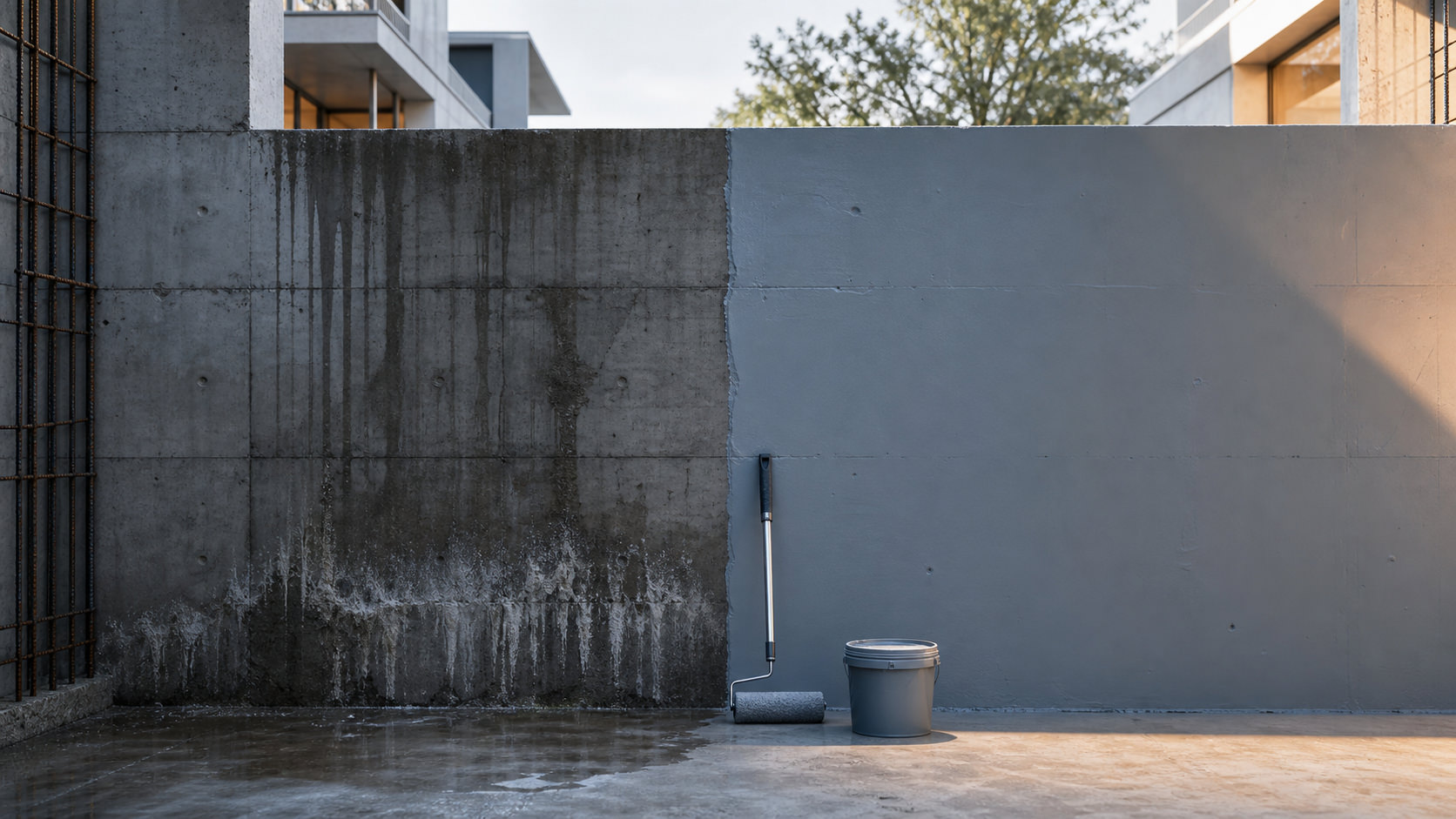
The question is not "which waterproofing product to use" but "what pathology do I have in front of me". Applying the wrong product is what causes 80% of re-interventions within a few months.
Three pathologies, three solutions
1. Capillary moisture — chemical barrier or surface water repellent
Water rises from the base of the wall by capillary suction. The solution is to cut the ascent: chemical barrier injected at the base of the wall or surface application of water repellent on exposed walls.
Surface water repellents in exposed exteriors: Hidrofa (water-based) or Hidrofa D (solvent-based for highly absorbent substrates).
Porous substrates like natural stone or aged mortar: Hidrofa 500 repels water without altering the appearance or color.
If the pathology is anticipated in new concrete, a mass water repellent in the mix is the most durable method: Hidro-masa.
Important: the water repellent does not waterproof against hydrostatic pressure. It only blocks capillarity and incident rainwater.
2. Pressure leakage — continuous barrier below ground level
When the wall is buried and bears water pressure, the water repellent is not sufficient. A continuous barrier must be created on the side facing the ground.
External face of buried wall (foundations, basements): Impermu and Impermu A are bituminous emulsions for quick application with a brush or airless spray.
Repairing walls from the interior face (when excavation is not possible): Impercemt (osmotic waterproof cement) or Impercem Elas (waterproof and elastic two-component mortar) for substrates with active micro-cracking.
Active water paths (localized leakage): Net-Vias seals with ultra-rapid setting and allows for continued general waterproofing.
3. Roofs and joints — elastic polymer membrane
Roofs and singular points (connections, drains, expansion joints) are exposed to the elements and must absorb thermal expansions. Here, elastic membranes prevail:
Elasnet 1 (monocomponent) and Elasnet 2 (bicomponent, higher requirements) — elastic waterproof coatings applied with a brush or trowel.
Elasnet Fibra — fiber-reinforced variant, for wider crack bridges.
Sealpul 250 and Sealpul 400 — liquid polyurethane membranes; the 400 is walkable and resistant to direct UV.
Net-Trans — transparent membrane over exposed pavements (ceramic, natural stone) when the finish cannot be concealed.
Why they fail when mixed
Applying a water repellent on a wall with hydrostatic pressure creates a skin that peels off at the first cycle. Applying an elastic membrane on a wall with active capillary moisture traps moisture and produces blisters. Diagnosis first, product later.
Key compatibilities
Bituminous emulsions are not compatible with polyurethane membranes without specific primer. Surface water repellents must be applied on dry substrates and with complete curing time; do not layer coats in less than 24 hours unless the product's technical data sheet expressly allows it.