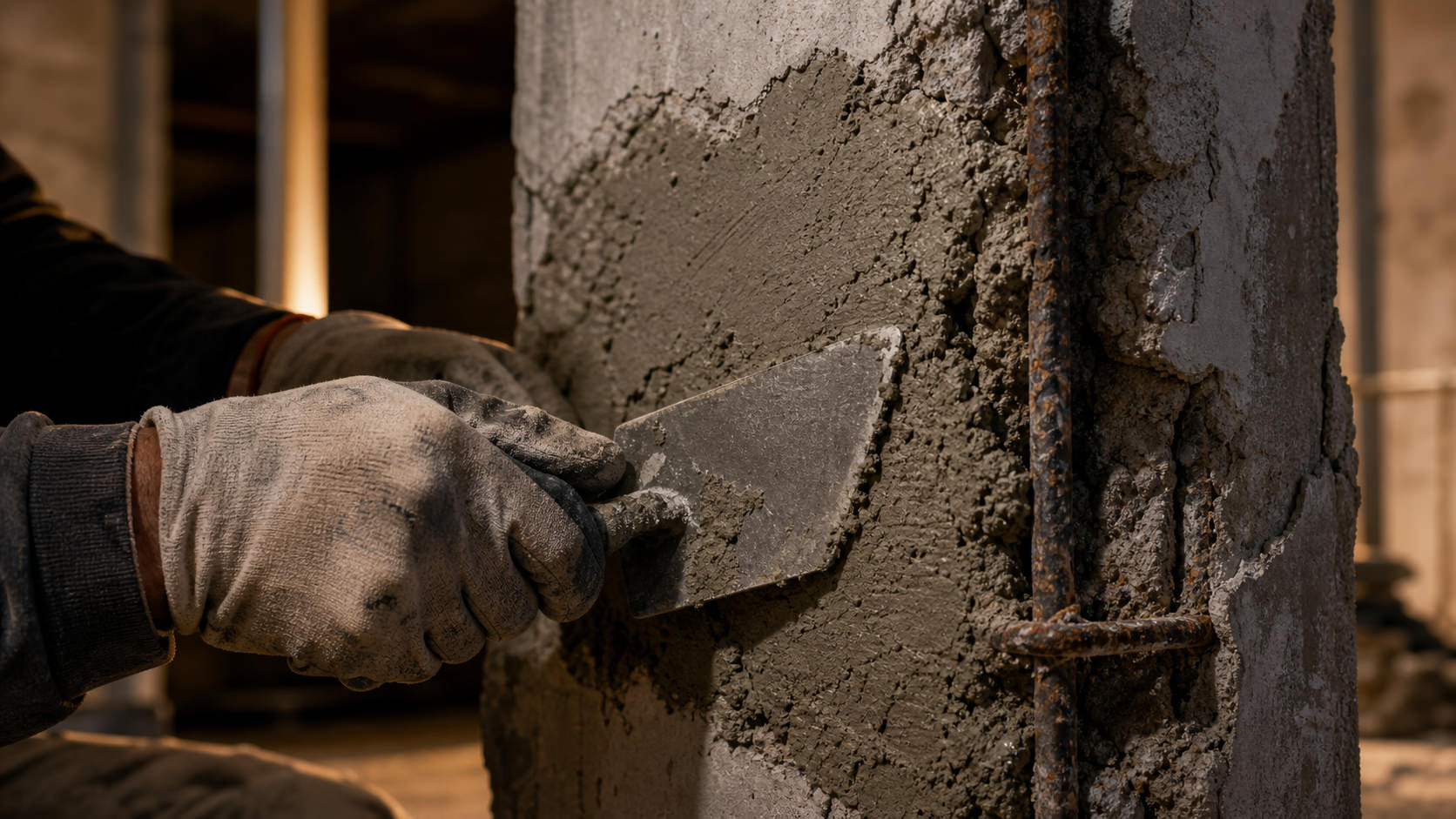
The standard UNE-EN 1504-3 classifies concrete repair mortars into four classes — R1, R2, R3 and R4 — based on their compressive strength and structural capacity. Choosing the right class is not optional: using an R1 where an R4 is required compromises the integrity of the repair; using an R4 where an R2 suffices increases the cost without adding value.
Differences between classes R1, R2, R3 and R4
The classes are defined by the compressive strength at 28 days and are divided into two groups: non-structural (R1, R2) and structural (R3, R4).
R1 — ≥ 10 N/mm². Cosmetic and non-structural repairs indoors. Low cost, easy application.
R2 — ≥ 15 N/mm². Non-structural repairs with higher demands: exterior coatings, surface leveling.
R3 — ≥ 25 N/mm². First structural level. Repairs of elements subjected to loads but not critical: edges of columns, screeds, light anchors.
R4 — ≥ 45 N/mm². High structural. Recovery of columns, beams, slabs or any element critical for structural safety.
How to decide on site
The main criterion is the structural role of the repaired element. If the element transmits significant loads or is part of the load-bearing skeleton, R3 or R4. If the repair is aesthetic or protective against aggressions (carbonation, chlorides), R1 or R2 usually suffice.
The second criterion is the depth and volume of the repair. Thicknesses less than 1 cm fit well with fluid R1/R2. Replacement of structural mass above 3 cm requires R3/R4 with graded aggregates to control shrinkage.
How it fits with the Quimicasur catalog
Our line of repair mortars covers both ends of the range — the cosmetic and the high structural — because they concentrate most of the demand on site. For pure intermediate classes R2/R3, an R4 worked in a thin layer is usually specified or a cosmetic with enhanced performance is selected:
Cosmetic and thin layer repairs (functional R1): Reparnet Cosmetic, in thicknesses of 1 to 5 mm, repaintable after 4-24 h depending on the finish.
Structural repairs (R4, ≥ 45 N/mm²): Reparcem (compressive strength 28 d ≈ 52 N/mm², thicknesses 5-50 mm) for columns, beams, and slabs.
Anchors and non-shrink fills: Morflu, fluid, expansive when fresh, compressive strength 28 d ≈ 80 N/mm² for base plates, bolt fixing, and fills under support.
In structural repairs, it is advisable to finish with a bond bridge: Promores 1 (cement-based) for almost all cases, and Epoxnet (two-component epoxy) when the adhesion test requires it or the element is subjected to tension.
Common mistakes
The most frequent: applying R3/R4 in layers less than 1 cm, where shrinkage causes micro-cracking. For those thicknesses, there are specific R3 thin layer mortars; consult the technical data sheet before ordering.
The second: not properly preparing the substrate. Mechanical cleaning down to sound concrete, removal of rust on reinforcements (abrasive blasting or wire brush), application of epoxy or cement bond bridge according to the regulations of each product.
Compatibility and regulations
In addition to class R, check the CE marking of the product and the compatibility test with the existing concrete (elasticity modulus, thermal expansion coefficient). A repair that is too rigid on a flexible substrate will detach in the medium term.