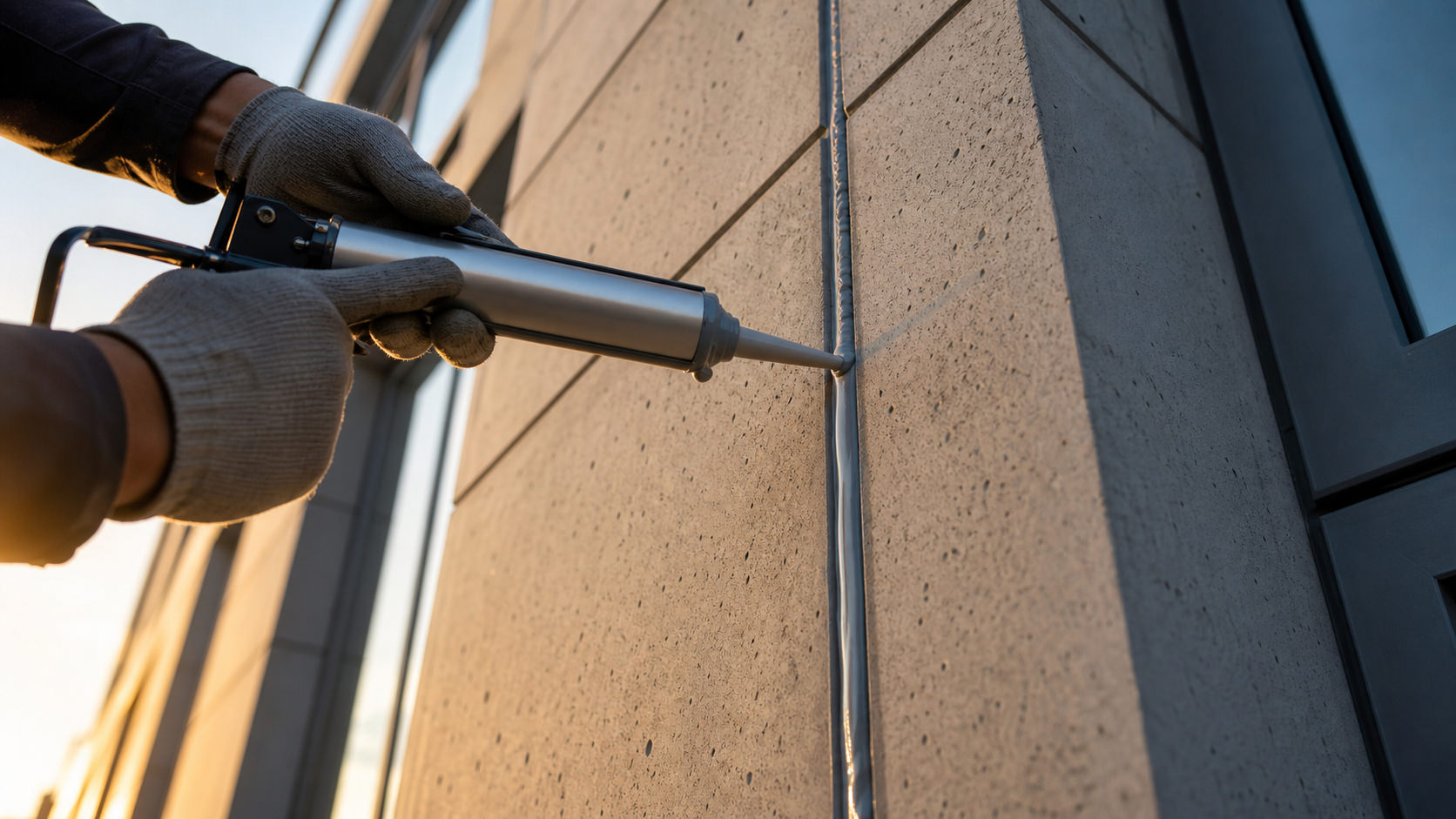
A poorly sealed joint leads to moisture, efflorescence, detachment, and even corrosion of nearby reinforcements. Most failures do not come from defective products: they arise from choosing the wrong sealant for the substrate and the type of movement that the joint must absorb.
Three dominant families
In outdoor construction, three dominant chemistries coexist today:
Polyurethane (PU). Excellent adhesion to concrete, mortar, and wood. High allowable deformation (±25%). Paintable. Sensitive to prolonged direct UV: in exposed joints, it requires finishing or painting.
Neutral silicone. Unmatched UV resistance. Not paintable. Limited adhesion on porous substrates without primer. Ideal for glass-aluminum and glazed facade joints.
MS polymer (silane-modified). A compromise between both: good UV resistance, paintable, adhesion to most substrates without primer. Slightly higher cost.
How to decide
Start with the substrate and the finish. Will you paint over it? Discard silicone. Exposed glass or anodized aluminum? Neutral silicone. Painted concrete, wood, mortar, expansion joints? PU or MS polymer.
Then look at the expected deformation. An expansion joint that moves ±15-25% needs a sealant with a class 25 rating or higher (UNE-EN 15651). For decorative joints with minimal movement, class 12.5 is sufficient.
What Quimicasur offers
Our catalog covers the two chemistries that dominate construction work: polyurethane and MS polymer. Neutral silicone is optimal for glass and anodized aluminum joinery, but it falls outside the construction focus we work on.
Juntanet MS — high-performance MS polymer. Paintable, great initial adhesion without primer on concrete, mortar, wood, and most metals. First choice for joints exposed to UV.
Juntanet — one-component polyurethane. High allowable deformation and excellent adhesion on construction substrates; protect it with paint or finish if the joint is exposed to direct sunlight.
Butilnet — cold butyl adhesive tape. For quick sealing of overlaps (roofs, gutters) where there is no significant structural movement.
Per-Expan — hydro-expansive profile for concrete joints. It is placed before the second pour and reacts with water if there is leakage, sealing by pressure.
Preparation: 80% of success
Dry, clean, and dust-free substrate. Minimum joint width of 6 mm; recommended depth equal to the width up to 12 mm, and half for larger joints. Polyethylene backer rod to control depth and prevent adhesion on three sides.
Priming according to the manufacturer's data sheet. Application with a gun in a continuous bead, immediate smoothing with a wet spatula. Skin formation time: check the technical data sheet before starting.